Leave Your Message
Choosing quality Wax Print Fabric for wholesale is not a visual exercise alone. Bright colors can hide weak fibers, uneven printing, or excessive shrinkage. For buyers, one attractive sample is not enough. The fabric must perform after washing, cutting, sewing, and repeated use.
The global textile system is under increasing scrutiny. Textile Exchange’s Materials Market Report 2024 estimates that global fiber production reached about 124 million tonnes in 2023. It could exceed 160 million tonnes by 2030. These figures make material efficiency and product durability important purchasing concerns. McKinsey and The Business of Fashion also describe fashion growth as cautious and cost-sensitive in their State of Fashion 2025 report. Wholesale buyers therefore need dependable quality, not only fashionable patterns.
Look closely at the fabric surface. A clear print should remain aligned across the width. The reverse side should show consistent penetration, without large pale patches. Ask suppliers for fiber composition, fabric weight, colorfastness, shrinkage, and production-batch records. Independent testing can reference recognized methods, including ISO 105 for colorfastness and ISO 6330 for domestic washing procedures. A practical check is simple: wash a measured 50-centimeter sample, dry it, and compare its size and color under daylight. Strong fabric feels stable. Weak fabric tells you quickly.
No checklist is perfect. Supplier records may be incomplete, and small defects can escape inspection. That is why physical sampling, laboratory evidence, and clear quality agreements should work together. This guide explains how to assess Wax Print Fabric before committing to wholesale quantities.
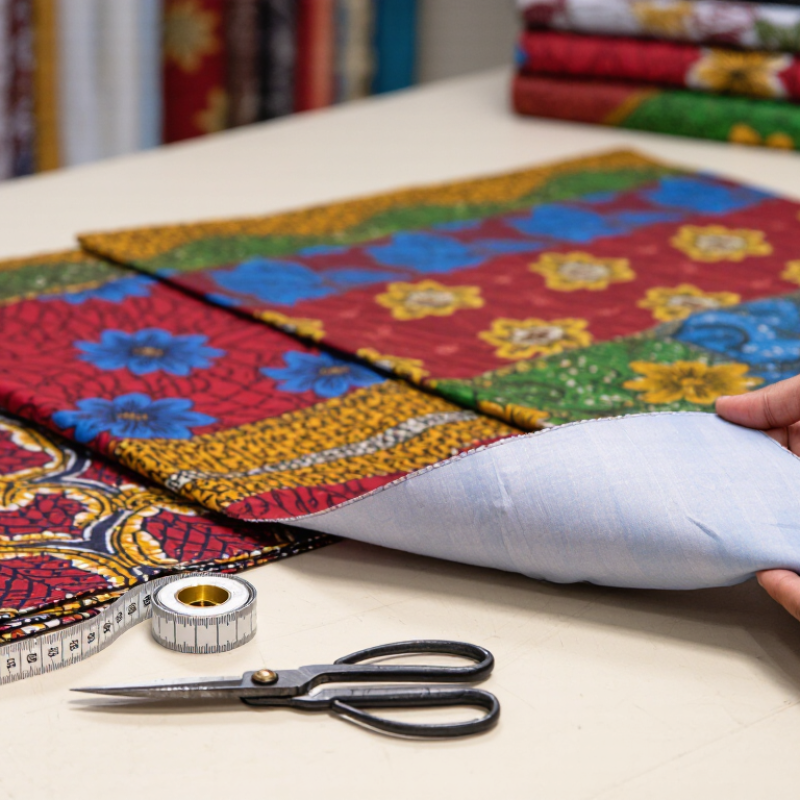
Choosing quality wax print fabric for wholesale begins with clear, measurable standards. Inspect the cotton or cotton-blend composition, fabric weight, weave density, and surface feel. A reliable fabric should feel firm, not brittle, with evenly finished selvedges. Hold it against light. Uneven gaps may reveal weak weaving. The printed motifs should align across the fabric width, with sharp edges and balanced color coverage.
Colorfastness deserves careful testing. Rub a dry and damp white cloth over dark areas, then check for transfer. Wash a sample according to the intended care instructions. ISO 105-C06 or AATCC 61 methods can support laboratory checks, depending on the target market. Measure shrinkage before ordering large quantities. A two-percent change may be manageable, but unexpected distortion can damage cutting plans. Ask suppliers for recent test reports, production specifications, and batch samples.
Wholesale quality also depends on consistency. Compare samples from different rolls, checking shade, width, thickness, and motif registration. A bright first impression can mislead. A fabric may look excellent under showroom lights but bleed after washing. That mistake is costly. No inspection is perfect. Keep sealed reference samples and record every result. Smaller trial orders often reveal problems that certificates alone cannot show. Reliable decisions come from documents, physical testing, and repeated comparison.
| Quality Dimension | Recommended Wholesale Benchmark | How to Check | Why It Matters |
|---|---|---|---|
| Fiber Composition | 100% cotton is the traditional specification for wax print fabric. If a blend is offered, the exact fiber percentages should be declared on the purchase order. | Review the technical specification and verify with a recognized fiber-composition test method such as ISO 1833. | Fiber content affects comfort, absorbency, durability, dye uptake, care instructions, and labeling compliance. |
| Fabric Weight | Approximately 115–160 g/m² for many lightweight to medium-weight cotton wax print qualities. The agreed tolerance should normally be stated in the purchase order. | Take samples from different rolls and measure mass per unit area according to ISO 3801 or an equivalent method. | Consistent weight supports predictable garment performance, cutting yield, opacity, and wholesale pricing. |
| Fabric Width | Common commercial widths include approximately 44/45 inches and 58/60 inches. Usable width should be specified separately from selvedge-to-selvedge width. | Measure at several points across the roll without stretching the fabric. | Width consistency affects marker planning, fabric consumption, garment costing, and cutting efficiency. |
| Weave and Surface | A stable plain weave with an even, clean surface; no excessive slubs, thick places, holes, open ends, or prominent weaving bars. | Inspect both sides under consistent lighting and assess multiple sections from each roll. | Surface defects can reduce cutting yield and become highly visible on finished garments. |
| Print Registration | Motifs, outlines, and color layers should align consistently. A practical commercial target is no conspicuous misregistration; any numerical tolerance should be agreed for the specific design. | Compare repeated motifs across the fabric width and length using a ruler or approved reference sample. | Poor registration creates blurred edges, uneven motifs, and a visibly low-grade appearance. |
| Color Consistency | Color should remain consistent from roll to roll and across the usable width. Approve a physical shade band or sealed sample before bulk production. | Use controlled lighting and compare bulk rolls with the approved standard; instrumental color assessment may be used where required. | Shade variation can cause mismatched garments and complicate replenishment orders. |
| Colorfastness to Washing | A common commercial target is grade 3–4 or better for color change and staining, unless the buyer specifies a higher requirement. | Test using ISO 105-C06 or an equivalent agreed method, with the applicable wash program recorded. | Good wash fastness reduces fading and color transfer during consumer laundering. |
| Colorfastness to Rubbing | A practical target is grade 3–4 or better for dry rubbing and grade 2–3 or better for wet rubbing, depending on the depth of shade. | Use ISO 105-X12 or an equivalent crocking method for dry and wet rubbing. | This helps prevent dye transfer onto skin, bags, upholstery, and contrasting garments. |
| Colorfastness to Perspiration | Grade 3–4 or better is a commonly used commercial target for color change and staining. | Test with ISO 105-E04 under both acidic and alkaline perspiration conditions. | The test indicates how the print may perform during wear in warm or humid conditions. |
| Dimensional Stability | For many cotton apparel applications, shrinkage within approximately ±3% after the agreed care cycle is a useful purchasing target. | Wash and condition samples according to the intended care label, then measure changes using ISO 5077 or ISO 3759. | Controlled shrinkage improves garment sizing, shape retention, and production planning. |
| Tensile and Tear Strength | Results should meet the buyer’s end-use specification and remain balanced in both warp and weft directions; no weakness should be visible around printed or finished areas. | Use agreed textile strength methods such as ISO 13934-1 for tensile strength and ISO 13937 for tear strength. | Adequate strength reduces seam failures, tearing during cutting, and damage during laundering. |
| Print Coverage and Wax Effect | The printed surface should be even, with clear crackle or wax-effect details where specified, without excessive pinholes, streaks, smudges, or unprinted patches. | Inspect against the approved strike-off or sealed sample at normal viewing distance and under bright, even light. | Print coverage and surface character strongly influence perceived quality and retail acceptance. |
| pH and Chemical Safety | For skin-contact apparel, a mildly acidic to neutral extract, commonly around pH 4.0–7.5, is often specified. Restricted substances must follow the destination-market requirements. | Request a laboratory report using an agreed textile pH method and a restricted-substance test appropriate to the destination market. | Chemical compliance supports consumer safety, import clearance, and responsible sourcing. |
| Roll Length and Joints | Roll length, roll-count tolerance, and permitted joints should be stated in the contract. First-quality rolls should have clearly identified joints and no concealed short pieces. | Measure roll length and record every joint, splice, or visibly damaged section during inspection. | Accurate roll information improves production scheduling and prevents unexpected fabric shortages. |
| Defect Inspection | Use a documented 4-point inspection system and agree the maximum points per 100 square yards or per 100 linear yards before shipment. Critical defects should not be accepted. | Inspect a statistically agreed sample of rolls on a fabric inspection machine or under controlled lighting. | A defined inspection system makes quality decisions measurable and consistent across wholesale shipments. |
| Packaging and Traceability | Each roll should be protected from moisture, dust, and crushing, with readable identification showing lot number, color reference, roll length, width, and fabric specification. | Check packaging integrity and match roll labels with the packing list, inspection report, and approved order details. | Traceability simplifies claims, replenishment, shade matching, and inventory control. |
Note: The numerical values above are commonly used commercial benchmarks rather than universal legal limits. Final acceptance criteria should be confirmed according to the fabric’s end use, destination market, care label, approved reference sample, and purchase contract.